


Finally Removing the “Wait and Hope” Pipeline Step in Microsoft Fabric
Blog by: Gareth Wilson, BI Manager at Climber
Introducing the new SQL Endpoint Refresh capability
Microsoft’s June 2026 Fabric release introduced a number of updates across Data Factory, Data Engineering, Power BI, AI, Real-Time Intelligence and Data Agents. While many of the headlines focused on AI, one of the most practical improvements for day-to-day Fabric users may actually be the new SQL Endpoint Refresh capability.
It is not flashy. It is not AI. But it solves a problem that almost every Fabric team has encountered at some point and, although still in preview, it shows how Microsoft is genuinely listening to its customers!

The challenge with SQL Analytics Endpoints
One of the strengths of Microsoft Fabric is the ability to expose Lakehouse data through a SQL Analytics Endpoint.
This allows:
- Power BI reports to query Lakehouse data using SQL
- Analysts to use familiar SQL tooling
- Data teams to build semantic models and reporting layers on top of Delta tables
- Business users to access data without needing Spark knowledge
The challenge has always been freshness. A common question from users has been:
“The data has landed in the Lakehouse. Why can’t I see it yet in the SQL Endpoint?”
Historically there could be delays between data arriving in the Lakehouse and metadata being available through the SQL Analytics Endpoint. For operational reporting and near real-time analytics, that delay could become frustrating.
Enter Refresh SQL Endpoint
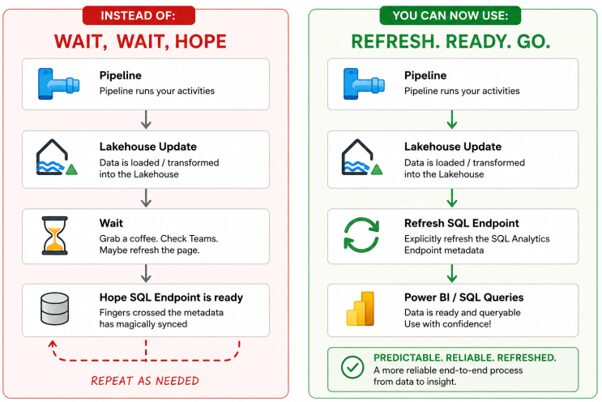
Microsoft has now introduced a dedicated Refresh SQL Endpoint activity within Fabric Data Factory. The purpose is simple:
After data is loaded or transformed, you can explicitly refresh the SQL endpoint rather than waiting for metadata synchronisation to occur naturally.
Think of it as the missing orchestration step that many Fabric teams have been manually working around. This creates a much more predictable end-to-end process.
Better Data Freshness Across Fabric
Microsoft has also introduced a new enhanced metadata synchronisation capability for SQL Analytics Endpoints.
The goal is ambitious: A 30-second freshness service level objective once Delta log changes are available in storage.
This is a significant improvement for organisations building:
- Near real-time dashboards
- Operational reporting
- Data-driven alerts
- AI-powered analytics
- Fabric Data Agents
The gap between data landing and data being queryable continues to shrink.
Where the real use cases are
Operational Reporting
Many organisations refresh data throughout the day but still rely on scheduled Power BI refreshes or delayed reporting windows. Using SQL Endpoint Refresh as part of the pipeline allows reports to become available much sooner after data arrives.
Examples include:
- Daily sales reporting
- Stock availability dashboards
- Manufacturing monitoring
- Logistics tracking
Data Warehousing
Fabric Warehouses and Lakehouses increasingly coexist within the same architecture.
A common pattern is:
- Land data into Bronze
- Transform into Silver
- Publish to Gold
- Expose through SQL Analytics Endpoint
The new refresh capability gives teams a reliable final step before downstream reporting and semantic models begin querying data.
AI and Data Agents
As organisations start adopting Fabric Data Agents and Copilot experiences, freshness becomes even more important.
Users expect answers based on the latest available data when asking questions such as:
- Why were sales down yesterday?
- Which stores are underperforming?
- What stock issues occurred this morning?
Reducing endpoint lag improves trust in AI-generated insights and conversational analytics.
Why this matters more than it sounds
Many Fabric updates focus on adding new capabilities. This update improves reliability. Those are often the features that end up delivering the biggest business value.
Nobody gets excited about metadata synchronisation. Everyone gets excited when:
- Reports show the latest data
- Dashboards refresh when expected
- Users stop raising support tickets
- AI tools return accurate answers
The new SQL Endpoint Refresh capability helps move Fabric closer to a truly real-time analytics platform, while giving data teams more control over how and when data becomes available to consumers.
Final Thoughts
June 2026 was another substantial month for Microsoft Fabric, with new capabilities across AI, Data Agents, Data Factory, Fabric MCP, Fabric IQ and Real-Time Intelligence. However, the new SQL Endpoint Refresh feature stands out because it addresses a practical challenge that many Fabric customers face today.
It may not be the headline feature from the release. But for organisations building trusted reporting, operational dashboards and AI-driven analytics on Fabric, it could easily become one of the most valuable.
WANT TO KNOW MORE? CONTACT US!
Gareth Wilson
BI Manager
gareth.wilson@climberbi.co.uk
+44 203 858 0668
Alex Booth
Business Development Manager
alex.booth@climberbi.co.uk
+44 203 858 0668
News archive
Four Storage Models, Different Workloads
Discover how Qlik Talend Cloud can help reduce duplication, simplify maintenance, and support different storage models for different data workloads. Join us in this webinar on 14th October.
>> Register now
Who Can Access Your Qlik Analytics?
By bringing analytics and BI applications together through a single, branded front door, Fusion makes it easier for users to access relevant insights. Join our webinar on 13th October for a live demonstration.
>> Register now
Your Data’s in Qlik – But Is Your Budgeting & Forecasting Still in Excel?
Join us on 6th October to see how Inphinity Forms can create a more controlled and connected approach to budgeting, forecasting, and approvals directly within Qlik Sense.
>> Register now