


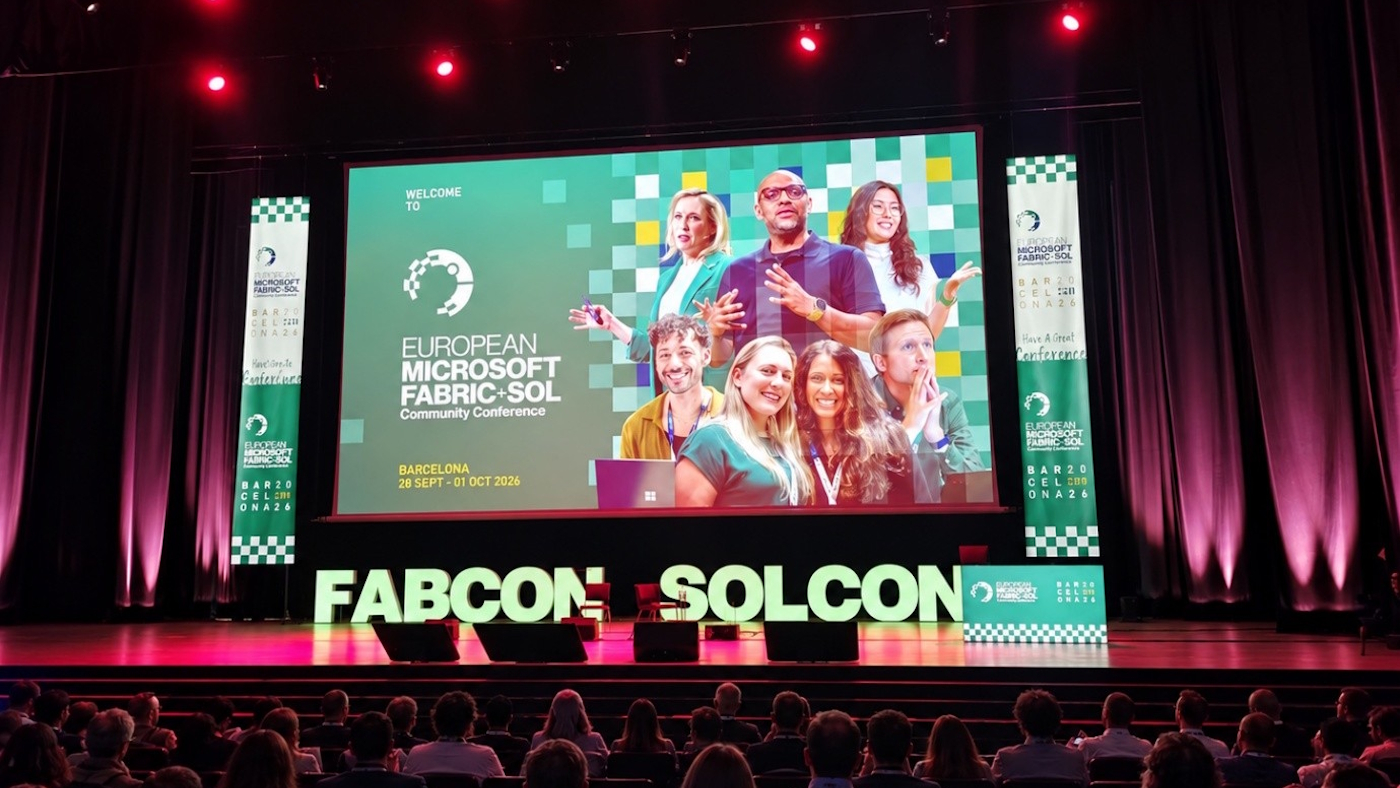
FabCon Europe 2026
Written by: Gareth Wilson, BI Manager at Climber
My take on Microsoft’s latest Fabric announcements
I recently spent a few days in Barcelona at FabCon Europe 2026, getting properly into what’s next for Microsoft Fabric, Power BI, and the wider Microsoft data and AI ecosystem.
There were some significant announcements, particularly around AI, application development and how Fabric is consumed. It was also good to hear from organisations using Fabric, rather than just seeing what it can do in a demo.
One theme kept coming up throughout the conference: context.
Microsoft is increasingly positioning Fabric as more than just a data platform. With OneLake, Microsoft IQ, ontologies, and AI agents, it’s starting to look like the central nervous system for a business. These are the announcements that stood out to me.
Fabric IQ and ontologies
For me, this was probably the biggest theme of the conference. Fabric IQ is Microsoft’s approach to giving AI a better understanding of your business through governed data, semantic models, metrics, and business relationships.
One of the announcements was an AI-assisted way to build ontologies from existing Power BI semantic models, OneLake data, and business documentation. An ontology describes how things within your business relate to one another. What a customer is, how they relate to an order or product, how margin is calculated, and the rules behind those relationships. Most businesses already have huge amounts of data. The problem is that the meaning behind it is often stuck in people’s heads.
Microsoft also announced that Fabric IQ integration with Copilot Chat and Cowork is now generally available, allowing Copilot to use governed Power BI data and business definitions. It’s not just about chatting with your data anymore. It’s about chatting with your business. Rather than asking AI what sales were last month, imagine asking why they’re falling, what’s driving it, who is working on the problem, and what should happen next. For AI to genuinely help answer those questions, data alone isn’t enough. It needs context.
AI agents, Microsoft IQ, and business skills
There was a lot of discussion about how AI agents are developing beyond simply answering questions. Microsoft is bringing together different types of business context through Microsoft IQ, including Fabric IQ for understanding business data and Work IQ for understanding how people and organisations work.
Business skills in Work IQ add another interesting element. They allow organisations to define reusable instructions and processes that agents can follow when carrying out business tasks, with integration into Dataverse and Power Platform applications.
It’s an interesting direction. AI can understand what the data means, connect that information to what’s happening across the organisation and, where the right capabilities and permissions exist, help carry out actions.
Microsoft also announced a new Fabric data engineering agent, currently in preview, that can plan and execute more complex data engineering work, including migrations, transformations and optimisation.
My main takeaway from the agent sessions was fairly simple. If your business concepts are poorly defined, your AI will be vague. If your metrics are inconsistent, your AI will confidently repeat those inconsistencies. And if your semantic models are weak, your agents will struggle. You still need to do the hard work underneath.
Fabric Apps and the evolution of Power BI
As a Power Apps developer, Fabric Apps was one of the sessions I made sure I attended. Fabric Apps allows developers to build interactive applications directly on governed Fabric data, including warehouses, lakehouse SQL endpoints, SQL databases, and Power BI semantic models. The latest announcements include backend functions, application storage, additional data connectors, and improved security and monitoring capabilities.
Microsoft also announced an upcoming Power BI Desktop experience that will allow users to generate applications using natural language, starting from an existing semantic model. These apps will support inputs, write-back, and operational workflows. That Power BI experience is planned for preview, including access for Power BI Pro and Premium Per User customers.
The distinction between the products is becoming much clearer to me. Power BI reports and analyses information. Power Apps handles operational processes, forms, approvals, and workflows. Fabric Apps provides a way to build guided application experiences directly over your analytical data.
Think of the times you’ve tried to force Power BI into behaving like an application using buttons and bookmarks. Or built a Power App that’s essentially a view over a large table, only to start working around delegation limits. Fabric Apps could bridge that gap quite nicely. It’s definitely one I’ll be spending more time with.
F0 capacity and on-demand billing
One of the more interesting commercial announcements was F0 and on-demand billing. Microsoft announced a new zero-provisioned capacity model called F0, which will allow organisations to use supported Fabric services without committing to provisioned compute capacity upfront. Instead, compute will be charged based on consumption.
Microsoft also announced on-demand billing for existing Fabric capacities, allowing supported workload categories to be charged separately rather than consuming the capacity’s shared compute allocation. Both capabilities were announced as coming to preview.
I’ve always thought Fabric could benefit from more flexibility around capacity consumption, particularly for development, testing, and workloads that only run occasionally. The traditional capacity model works well for predictable workloads, but not everything needs to run 24 hours a day.
I’m interested to see how the costs compare in practice. Consumption-based billing doesn’t automatically mean cheaper, but having another option is welcome.
Real-Time Intelligence
I attended a really interesting session on H&M and how they’re using Fabric to turn retail data into real-time decisions. Microsoft’s published example looks at how H&M is bringing together inventory information from different tracking systems across its stores to get a clearer picture of where garments are and identify potential stock losses.
Some of those systems update every few minutes, while others rely on daily handheld scans. Bringing that information together is a good example of the operational challenges that Real-Time Intelligence can address.
Microsoft also announced further Real-Time Intelligence capabilities, including Copilot-assisted dashboard creation, eventhouse management, and AI-supported operational investigation.
For me, the H&M session demonstrated where Fabric can become much more useful than another reporting platform. In retail, yesterday’s data isn’t always good enough. Stock, demand, and customer behaviour can change quickly.
A unified data foundation in OneLake, Real-Time Intelligence for operational signals, Power BI for analysis, and Fabric IQ for business context is an interesting combination. Retailers that get this right won’t just report faster. They’ll be able to react faster too.
Fabric observability
Another announcement that caught my attention was Fabric observability. Microsoft introduced new monitoring capabilities, currently in preview, that bring together information across workspaces, jobs, and capacities.
These include a refreshed Monitor Hub, centralised workspace monitoring, and AI-assisted investigation of failures. Anyone who’s worked on larger Fabric implementations will know that troubleshooting failures or working out where capacity is being consumed can be frustrating.
It’s good to see Microsoft continuing to improve the operational side of the platform. These aren’t necessarily the features that attract the most attention at a conference, but they’re the ones that can make life considerably easier when you’re supporting Fabric in production.
My thoughts after Barcelona
I came away from FabCon feeling that Microsoft is starting to connect the different parts of its data, analytics, and AI ecosystem much more closely. Fabric is becoming more than a platform for bringing data into OneLake, transforming it, and building Power BI reports.
With Fabric IQ, ontologies, Work IQ, and agents, Microsoft is putting serious investment into helping AI understand the business around the data. The metrics, definitions, relationships, ownership, and rules that sit behind the numbers.
I think that’s a significant change. But it also reinforces something we’ve been talking about for years. Having lots of data doesn’t automatically make an organisation data driven. You still need clear business definitions, consistent metrics, strong governance, and an understanding of the decisions you’re trying to support.
And however capable AI agents become, I still think people need to remain firmly in the loop. AI can help identify problems, understand relationships, and recommend actions, but judgement should ultimately sit with people.
Plenty to take away from Barcelona, and quite a few new features I’m looking forward to getting properly hands-on with over the coming months, watch out for some more in-depth blogs on these new features!
SUBSCRIBE
Want to stay up to date with the latest features in Microsoft Fabric and Power BI?
Subscribe to our blog and get monthly updates directly to your inbox.
WANT TO KNOW MORE? CONTACT US!
Gareth Wilson
BI Manager
gareth.wilson@climberbi.co.uk
+44 203 858 0668
James Merrills
BI Consultant
james.merrills@climberbi.co.uk
+44 203 858 0668
News archive
FabCon Europe 2026
Climber recently spent a few days in Barcelona at FabCon Europe 2026, getting properly into what’s next for Microsoft Fabric, Power BI, and the wider Microsoft data and AI ecosystem.
>> Read more
What’s New in Qlik Cloud – October 2026
Qlik Answers gains Fast and Thinking modes for assistants and your AI assistant can now build scheduled and triggered automations. Qlik Data Integration also has a good mix of practical improvements and developments.
>> Read more
Your Data’s in the Cloud – But Are Your Reports Still Manual?
Join us on 20th October to see how automated reporting can work alongside Qlik Cloud to make information delivery more efficient, consistent, and scalable with Mail & Deploy.
>> Register now