


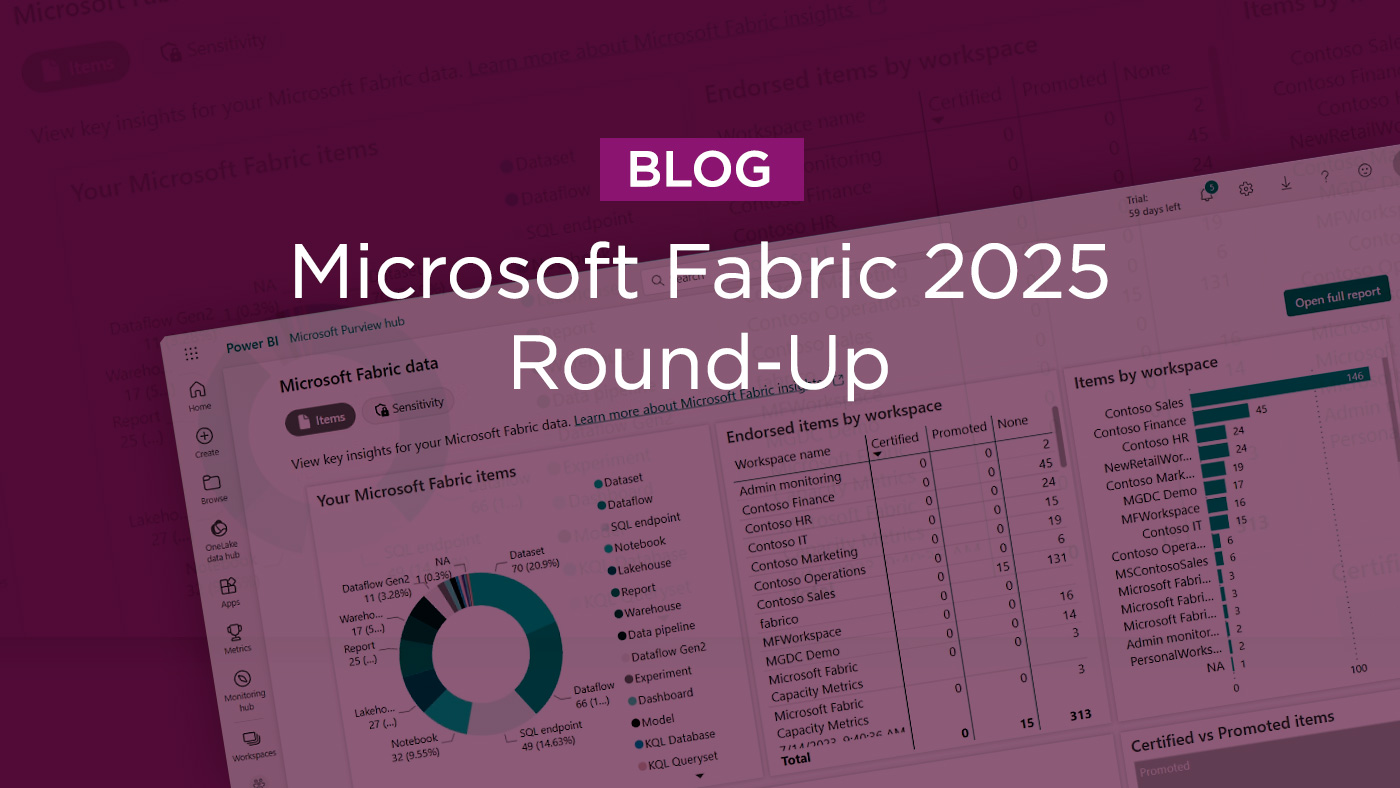
Climber’s Microsoft Fabric
2025 Round-Up
– What Actually Changed This Year –
Written by: Gareth Wilson & James Merrills, Business Intelligence Consultants at Climber
2025 was the year Microsoft Fabric stopped feeling “new” and started feeling usable at scale. Not because of slogans or vision decks, but because the rough edges that slow real teams down were gradually smoothed out. Things became more predictable, more controllable, and more enterprise ready.
This is our Climber view of what genuinely mattered in Fabric this year, based on projects, migrations, fixes, and lessons learned.
Dataflows Gen2 Finally Felt Production-Ready
Dataflows Gen2 improved a lot this year, especially in areas that previously caused frustration.
Notable changes we experienced immediately:
- Fewer random refresh failures
- Clearer errors when something breaks
- Better behaviour with SharePoint, APIs, and parameterised logic
- More predictable refresh times
Most importantly, teams started trusting dataflows for Bronze and Silver workloads, not just light prep. That trust is what allows proper separation of ingestion, transformation, and modelling.
Microsoft Power BI and Microsoft Fabric Started Feeling Like One Product
This year was the first time Power BI didn’t feel bolted onto Fabric.
Key differences in practice:
- Lineage views became genuinely useful for tracing issues
- Semantic models felt like a natural continuation of the data pipeline
- Security conversations started earlier because the model was clearer
- Fewer surprises when publishing and refreshing
This matters because analytics teams think in end-to-end flows, not individual tools.
Copilot was Helpful in Small, Specific Ways
AI didn’t replace anyone’s job this year. But it did save time in very specific places.
Where Copilot helped most:
- Writing and fixing DAX measures
- Generating SQL for simple transformations
- Explaining existing models to new team members
- Speeding up repetitive Power Query edits
Where it didn’t:
- Architecture decisions
- Data modelling
- Governance
- Performance tuning
Used properly, Copilot acted like a junior analyst who’s good at syntax and bad at judgement. That’s still useful.
Governance and Security Quietly Improved
Throughout 2025 we saw:
- Clearer workspace role separation
- More predictable permission inheritance
- Better alignment between Fabric security and Power BI RLS
- Fewer “why can they see that” moments
This wasn’t flashy, but it was important. It made it easier to design secure Gold layers instead of fighting the platform after the fact.
What We Learned at Climber in 2025
A few honest takeaways from real work:
- Fabric works best when you respect layers and responsibilities
- Silver and Gold modelling decisions matter more than tools
- Power BI problems are often data model problems upstream
- AI speeds things up but doesn’t replace thinking
- Simpler architectures survive change better
Most importantly, Fabric rewards discipline over cleverness.
Looking Ahead to 2026
If 2024 was about launch and 2025 was about stabilisation, then 2026 feels like it will be about optimisation and maturity.
What we’re watching closely:
- Better metadata and lineage at scale
- Stronger data quality and validation tooling
- Continued convergence of Lakehouse and Warehouse patterns
- More opinionated guidance from Microsoft on best practice
WANT TO KNOW MORE? CONTACT US!
Gareth Wilson
BI Manager
gareth.wilson@climberbi.co.uk
+44 203 858 0668
James Merrills
BI Consultant
james.merrills@climberbi.co.uk
+44 203 858 0668
News archive
What’s New in Qlik Cloud – April 2026
This month’s release expands AI capabilities into new regions, strengthens automation controls, and delivers governance updates for both administrators and app developers. There are also updates making Qlik Talend Cloud easier to work with day to day.
>> Read more
Microsoft Fabric for AI Readiness: Preparing Your Organisation for What’s Next
Join our 40-minute live webinar to discover how to prepare and structure your data so AI tools like Copilot can deliver trusted insights for your business.
>> Register now
How to Succeed with AI by Building an AI-Ready Data Foundation
In this 40-minute webinar, you’ll explore how a metadata-driven approach can transform how organisations build and manage their data environments to support AI, Automation, and Analytics.
>> Register now